

This study analyzes vowel changes in Latin-origin loanwords in modern Basque to establish a relative chronology of proto-Basque vocalism. Drawing on Michelena and Echenique, it examines lexis and phonology—domains highly permeable to contact—to reconstruct proto-Basque sound patterns. The findings illuminate language typology, hybridization, and historical sociolinguistic processes while suggesting future comparative research.
Latin-origin loanwords and the proto-Basque vowel system: Toward a relative chronology
Gandarillas, Marc
- Filiation:
- University of North Dakota. Department of Languages & Global Studies. 276 Centennial Drive. Grand Forks, ND 58202-8198 (USA) marc.gandarillas@und.edu
- Publication year:
- 2025
- Publication place:
- Donostia
- Characteristics:
- BIBLID [0212-7016; eISSN: 2953-4180 (2025), 70, 1]. - Reccep.: 2024-08-26; Acept.: 2025-11-07
- DOI:
- doi.org/10.61879/riev701zkia202505
- ISSN:
- ISSN: 0212-7016; eISSN: 2953-4180

1. Introduction
Basque (locally known as Euskera or Euskara) is a language spoken in the Basque Country and Navarre, in Spain, and in the cultural region known as Iparralde, in France. As a language that predates Romance languages, Basque has long been considered enigmatic in terms of its origin, with little consensus existing among scholars. From a diachronic viewpoint, the present study delves into the vocalic phonological system of proto-Basque, specifically based on Latin-origin loanwords that have persisted in modern Basque. Domain-wise, the focus is on lexis and phonology, partly based on Wagner’s (1951) timeless claim that “lexis tends to reveal language history even more straightforwardly than phonology, morphology, or syntax do.” The ultimate goal of this research is to establish a chronology of the vocalic changes experienced by proto-Basque as shown in a corpus of Latin-origin loanwords.
Based on prior literature to the extent possible, an in-depth review of the issue under study is conducted. After identifying the most frequent vocalic shifts in the phonological system of proto-Basque, a relative chronology of these changes is eventually established. The etyma used in this study constitute a selection of those provided in Michelena (1974, 20111, 20112) and Echenique (2012). Diachrony-wise, thus, the study focuses on proto-Basque and Latin-origin lexical items. Domain-wise, it is centered on lexis and phonology, which, as opposed to morphology or syntax, appear to be more permeable to language contact, especially in typologically distant languages (Sankoff 2001). This focus on lexis goes along the lines of Wagner's (1951) aforementioned claim. Considerations regarding intra-Basque geographical variation will eventually turn out to be paramount, as the present study comprehensively encompasses an etymological internal reconstruction (i.e., based on morphophonological features), as well as revising the minimal phonological system for proto-Basque, determining a relative continuum in terms of diachrony, and conducting an extensive word revision to exclude cases of subdifferentiation (e.g., h- words).
Despite currently coexisting with Spanish and French, Basque is typologically distinct from these languages. Uncertainties concerning the origin of the language pose a number of challenges when conducting diachronic studies of the language. Along these lines, Basque does not allow itself to be addressed from a comparative approach, which leaves internal reconstruction as the only feasible possibility. Internal reconstruction provides valuable insight into the complexity of the language, which is visibly reflected in major cross-variety divergences. In the 1960s, Basque varieties had grown ostensibly apart from each other to the extent that cross-variety comprehensibility had become challenging. To solve this situation, the language standard Euskara batua was eventually implemented in 1968, especially for use in mass media and with educational purposes. However, some cautionary tales have been told that this artificial variety—as successful as it has proved in preserving language unity—should not be used in historical language research in order to avoid drawing hurried, inexact assumptions (Michelena 1974).
Far from seeking to solve all the above-mentioned conundrums, I will limit myself to exploring the lexical items that Basque inherited directly from Latin. This will likely assist me in subsequently establishing the importance of such items. Specifically, I will explore the Basque-Latin and Basque-Romance contact through history in terms of lexical heritage. Along the way, a need will arise for questioning the validity of popular concepts like Euskañol within the field of so-called “language hybridization” (cf. critique of Spanglish in Otheguy & Stern, 2010). I expect the results of this research to potentially contribute new cross-disciplinary insights to areas of study ranging from historical linguistics to sociolinguistics to language typology. It is to this end that I have adopted appropriate methodologies following a validation and refinement process to harmonize traditional (i.e., language history) and more recent (i.e., applied linguistics, sociolinguistics) approaches. Aforementioned Michelena (1974) will provide a variety of valuable examples, some of which can also be found in more recent works by the same author (Michelena 20111, 20112). Echenique (2012) will also play a significant role. After determining the feasibility of establishing a relative diachrony of the phonological changes evinced by Latin-origin loanwords in Basque, I will go on to establish the intended diachronic continuum.
1.1. What we know about Basque-Latin contact
Basque is oftentimes claimed to be Europe’s oldest language still in use[1]. Apparently, Vasconia and Aquitaine were partially involved in intermittent Romanization attempts that eventually were—at least partly—successful. Romanization—and, most relevantly, Latinization—is likely to have performed as an urban-to-rural phenomenon (Echenique 2012). As for the Latinization process, this appears to intensify from its early stages (56 BC), notably along the southern Pyrenees. The decline of the Roman Empire goes hand in hand with a ruralization process, which Basque-speaking territories appear to have used to their advantage prior to attaining their maximum expansion—both east- and westward.
Figure 1. Geographical area of ancient Basque by the 1st century AD
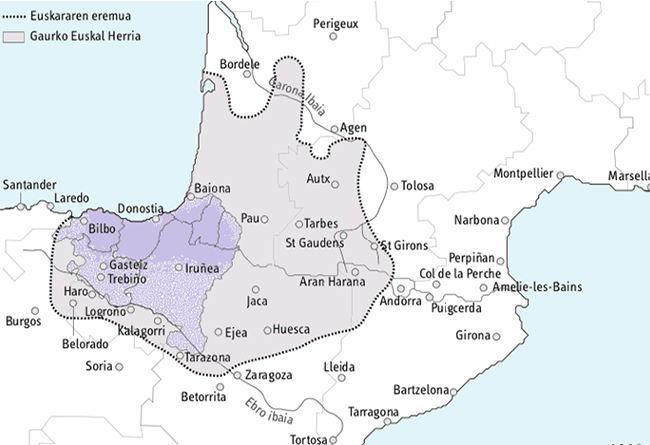
Source: Núñez Astrain (2003).
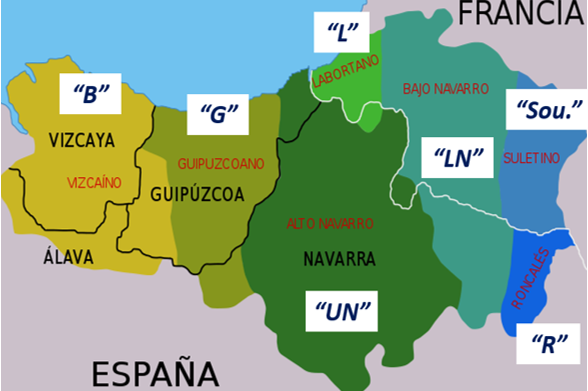
Figure 2. Varieties of Basque along with their abbreviations: B = Biscayan; G = Gipuzkoan; L = Lapurdian; UN = Upper Navarrese; LN = Lower Navarrese; Sou. = Souletin; R = Roncalese
1.2. Challenges
When approaching Basque from the perspective of historical linguistics, the first challenge that needs to be overcome is scarcity of research. Even when some information is available, this tends to demonstrate a noticeable lack of systematicity and completeness. Substantial intra-Basque variability poses yet another challenge (e.g., ahuntz/auntz/aintz “goat”). As mentioned earlier, the standardized Euskara batua (1968) does not appear to be a suitable baseline for the purposes of historical research. This situation becomes even more challenging in considering the unclear, diffuse origins of Basque, as well as the myriad difficulties faced when tracing the evolution of the language from its proto stages. Additionally, widespread evidence exists that Latinization was never homogeneous throughout the Basque-speaking territories, while early documentations of the language merely date back to the 16th century. While an absolute diachrony (i.e., one linking phonological changes with specific timeframes within the history of the language) does not appear to be feasible with the resources at hand, a relative timeline (i.e., one simply arranging the phenomena in the chronological order in which they likely occurred) might be more realistic.
2. Literature review
To date, there has apparently not been a satisfactory, systematic approach to Latin lexical heritage in Basque, as central as this appears to be to the language system. Research on the matter has not been comprehensive, but rather focused on anecdotal evidence or specifics. Multiple difficulties are added to such literary void when attempting to trace a continuum between Latin and the presumed linguistic reality of Vasconia. Michelena (1974) emphasizes how common so-called “partial etyma” are. This label is used as an umbrella term to encompass lexical pieces which—based on the typological gap existing between Latin and Basque—appear to be dissociated from their morphological content. In such etyma, a Latin word has shifted its lexical category (e.g., noun, verb) in transitioning to Basque, yet it has preserved either its original semantic load or—alternatively—a meaning deriving from the original archisememe. Intra-Basque cross-variety divergence—in addition to perceived documentary paucity in terms of language history—leaves a single choice for historical reconstruction of Basque-Latin—in a subsequent stage, Basque-Romance—contact, this being internal reconstruction based on phonological and/or semantic criteria.
Vasconia underwent a partial and intermittent process of Romanization, which likely radiated from urban centers (specifically, the two Iruñas—located, respectively, in Navarre and Alava—and Lapurdum, to the north). In these territories, Romanization became increasingly weak as it reached rural areas. It is widely accepted that the influence of Latin in Basque experienced a process of intensification from Publius Crassus’ campaign, in 56 BC, onward—and, possibly, well before, along the southern slopes of the Pyrenees. However, it was not until the decline of the Roman Empire (around the second half of the 3rd century AD) that Basque took advantage of the ruralization process to expand east- and westward and, eventually, attain its maximum geographical expansion.
Based on Michelena’s (1974), I was able to establish a relative seniority of loanwords according to the phonological changes shown therein. Michelena (1974) claims that “the most ancient loanwords are likely those that best preserve their original form, and also those that have incorporated the greatest number of changes to the original forms. In other words, these loanwords are likely to be ancient as long as they do not show any evidence for phonological shifts that eventually altered the neighboring Romance languages; however, ancient loanwords will also be those that have incorporated intra-Basque changes, since this is good proof that they had been incorporated into the lexicon of the language before their accomplishment.” The paradox here is only apparent: on the one hand, the more conservative loanwords are, the more ancient they can be deemed; on the other hand, the more these have evolved within Basque, the longer the evolutionary process can be considered. Therefore, it is necessary to identify the changes that can be attributed to intra-Basque evolution and, subsequently, isolate said shifts from those that might be explained otherwise (specifically, as a result of extended contact with neighboring Romance languages).
Michelena (1974) highlights that in modern linguistics there are two confronting stances concerning the delimitation of what an etymon is and is not. On the one hand, some scholars have claimed that an etymon is “every word that resembles such.” On the other hand, those defending a more traditional approach claim that virtually all Basque lexical items are patrimonial (i.e., have experienced internal evolution). Michelena (1974) also mentions the existence of adventitious components, evolutionary results which eventually seem to appear either alternatively or randomly, without being based on a clear reason or following a regular pattern. Relatedly, I presume that, for the results of this study to be significant and representative, it is essential to initially focus on “purely Latin” loanwords. These loanwords would occupy an intermediate stage, halfway between the Indo-European, pre-Latin terms (extremely scarce) and those that provide evidence for a fully Romance origin. Aside from the aforementioned intra-Basque variability—which forced me to propose a protoform for each of the main varieties—there are various cases of subdifferentiation that needed to be addressed (e.g., h- aspiration in the varieties spoken in the Iparralde region, in the French Basque Country).
3. Research questions and hypotheses
Based on the research goals and the literature reviewed, two research questions were formulated along with their respective hypotheses:
RQ #1: Is it possible to internally reconstruct a phonological system for proto-Basque?
I hypothesized that it is, even as intra-Basque variation initially appears to pose multiple challenges.
RQ #2: Is it feasible to classify Latin and Romance loanwords in modern Basque by means of a relative or absolute diachrony?
I assumed that a relative classification is likely to be successful—or somehow insightful. However, an absolute classification does not appear to be feasible with the data that we currently have at hand.
4. Preliminary considerations
It is highly likely that the phonological system of ancient Basque was simpler[2] than the one documented for classical Latin. As is documented for modern Spanish and most modern varieties of Basque, proto-Basque may have presented five units, /a e i o u/, containing three degrees of openness, which—unlike in the case of Latin[3]—appear to be insensitive to quantity. This system (which may have had some influence on proto-Spanish) is not length-based, as opposed to classical Latin, and, in addition to said vowels, would have presented a series of five falling (i.e., /aj/, /ej/, /oj/, /aw/, /ew/) and five rising diphthongs (i.e., /ja/, /je/, /jo/, /wa/, /we/). Thus, the vocalic system of proto-Basque would have been similar to that of modern Sardinian[4], in which the results for I and U have merged with those for Ĭ and Ŭ, instead of those for Ē and Ō. The following are only some examples: bikhe “fish,” bil(h)o “hair” (E), bipher “pepper,” makhila “stick, cane” (< PISCE, PILLU, PIPER, BACCILLU); biku “fig,” makhi(ñ)a “pig trough,” mira “to look at, to admire,” miru “kite” (< FICU, BACCINU, MIRA-, MIL); iztupa (S üztüpa) “tow,” lukuru “usury, interest,” lupu “wolf,” tipula “onion” (< STUPPA, LUCRU, LUPU, CEPULLA); berna “calf,” zela “saddle” (< PERNA, SELLA); meta “heap, pile,” moeta “class” (< META, MONETA); errota “wheel, mill,” ozte/oste “troop” (< ROTA, HOSTE); horma “wall, ice,” ohore “honor” (< FORMA, HONORE); ezpata “sword” (< SPATHA); merkhatu “market” (< MERCATU).
A highly frequent vocalic phenomenon is that Latin short vowels Ĭ and Ŭ respectively led to the outcomes e and o: balezta “crossbow,” mezu “notice, message” < MISSU, dorre “tower” < TURRE. At a later stage—and within the framework of internal shifts—stances of assimilation and dissimilation are found, some of which take a vowel as a starting point, while others stem from a consonantal phoneme. Here are some examples:
- siku “dry” < SECU: The close vowel might be due to the apical sibilant.
- tipula “onion” < CEPULLA: The i in the first syllable might be influenced by the close vowel in the following syllable.
- Especially in western varieties, i - u/ü > u - u / ü - ü: R ainguru, S aingürü < aingiru, aingeru “angel” < ANGELU.
Vacillation of i/u in labial or palatal contexts is also frequent: V mirillu “fennel,” R mullu, S mühüllü, pühüllü < FENUC(U)LU. Certain results raise questions, such as dekuma, which, according to Michelena (1974), might either be evincing the preservation of an archaic Latin vocalism (< DECUMA), or an «intra-Basque» ‘i > u’ evolution based on DECIMA. The latter possibility might be more feasible, since the archaic vocalism would have already been residual in the Latin varieties that reached the Iberian Peninsula through Romanization. Also, neighboring Romance languages do not generally show any evidence for having borrowed an archaizing vocalism.
The Basque treatment of the Latin diphthong AU is also worth mentioning. In western Romance languages this diphthong typically becomes the monophthong o (e.g., CAUSA > Sp./Cat./It. cosa, Fr. chose). Here are some examples concerning Basque: lauza “gravestone,” laida “to praise” < LAUDA-, gauza “thing” < CAUSA, kaiku “basket” < CAUCU; except: aditu “to pay attention, to understand, to hear” < AUDITU. These and similar examples provide evidence of the default maintenance of AU in Basque, alongside its adaptation as ai[5]. It is essential to distinguish the Basque results of AU from those cases in which the syncope of a middle consonant has occurred. In a number of varieties, this tends to leave the trace of an aspiration. For instance, ahuntz “goat” (Michelena 20111: 71-) coexists with variants auntz and (R) aintz.
However interesting and enlightening they may be, many of these examples remain out of the scope of the present paper since they are not Latinisms. Regarding the result ai as an alternative to au, this is typically found, according to the author, in “cases of widespread dissemination,” and is usually explainable based on the “dissimilatory action of the vowel in the following syllable (BN haizu, S háizü [izan] “to be legitimate, to dare” vs. AN/BN (h)auzu < AUSUS [SUM]). The same explanation applies to the cases in which the diphthong has lost its second element (see above aditu < AUDITU). While Michelena (1974) is more systematic in the treatment of Latin loanwords, Michelena (20111) is mostly synchrony-based, for which ‘au/ai < AU’ instances tend to appear alongside results that are not derived from Latin. Ultimately, it is important to consider, in this respect, that the Roncalese and Souletin varieties tend to show the result ai, except when prior to r, rr, s, and ts. Regarding Latin diphthongs AE and OE, their continuation is not as straightforward to establish. The origin (either Latin or otherwise) of some examples may be difficult to determine (e.g., S theiü (R texu) “dirty, impure” < TAEDIU (?)).
As for word-final vowels, loanwords appear to undergo better accommodation than in Romance languages, in which final vowels tend to be grammatically loaded (e.g., gender, which is not marked in Basque from a morphophonological viewpoint). Some examples of this are aita “father,” bare “spleen,” and begi “eye,” to name a few. Nouns and adjectives originating in Latin -O themes (i.e., from the second declension, in which masculine is the main gender) commonly conform to Basque as -u (older) or -o (more recent). Oftentimes both forms coexist across varieties (e.g., biku vs. fiko “fig” < FICU). In cases in which neither -o nor -u is present, the word will usually come from Occitan (e.g., V marti “March”). In the case of Latin words that originally pertained to the third declension, the preservation (addition?) of -e is commonly found, which was part of the accusative desinence (-EM), such as in amore “love” < AMORE. In this respect, it may be important to remember that, due to case syncretism, the accusative tends to be the only form that is preserved in western Romance (cf. plural: Sp. amores vs. It. amori). It is thus not uncommon that Latin loanwords in Basque provide relevant information on the morphology of western Romance.
In syllable-initial consonantal clusters, in most Basque varieties it is typical to find the insertion of an anaptyctic vowel, as in the following examples: apiriko “atrium, porch” < APRICU, garazia “grace” < GRATIA. This coexists with a less frequent solution that consists of eliminating C1 (e.g., EC(C)LESIA > eleiza > eliza “church”). A tendency is also found toward syncopation (i.e., a phenomenon that creates new consonantal clusters), unconditioned by the position of the stress (e.g., aizna “leisure” < OTIU, Mik(e)le “Michael” < MICHA(H)EL). This is a relatively recent phenomenon. The resort to a prosthetic vowel (either e or a) in Latin words starting with R is also a typical feature of Basque (e.g., errazoe “reason” < RATIONE, errege “king” < REGE).
It is important to note a couple of additional preliminary considerations. Firstly, the existence of an archaic form, one that is closer to Latin phonological idiosyncrasies, does not necessarily go hand in hand with increased seniority. Self-explanatory examples are found in the loanwords from late or medieval Latin, usually associated with ecclesiastical Latin: M epistiko, old G ipiztiku, old BN/L ipizpiku “bishop” (< EPISCOPU); denbora “time” (< TEMPORA); endel(e)ga “to understand” (< INTELLEGARE[6]). Secondly, the distance between Latin and Basque in terms of typological affiliation―thus, linguistic characterization―provides Basque with noticeable morphological flexibility when incorporating loanwords. In the absence of grammatical gender in Basque (which has a declension system different from that of Latin), multiple instances of lexicalized desinences may be found, which have lost their original grammatical load.
For example, CORPUS eventually results in gorputz “body,” in which -utz is a mere phonological continuation of Latin -US, which, in the context of the third declension, would indicate neuter gender. Following the loss of the neuter gender, in Romance -US was reinterpreted as a masculine, based on the analogy with -US nouns from the Latin second declension (e.g., POPULUS). This is the reason behind the masculine results of CORPUS in Romance (e.g., Cat. cos (simplification of corps), Sp. cuerpo, It. corpo, Fr. corps). TEMPORA becomes denbora in Basque and, due to the effects of lexicalization, etymological awareness is lost that in Latin -A used to mark the plural of a neuter noun (originally meaning ‘[the] times’). Along the same lines, in maizter “overseer” it has been forgotten that -ER was an allomorph in Latin used to indicate nominative case.
Likewise, in the compound Domisanthore “All Saints,” the latter constituent is rooted in the Latin genitive SANCTORUM (lit. ‘of the saints’). Maier “skilled, carpenter,” has even lost the notion provided by the comparative suffix -IOR, in MAIOR “major, larger.” However, one of the most evident examples may be found in lak(h)et [+ izan] “to like,” which is used in Basque alternatively as an adjective or as a basis for the creation of highly frequent periphrases (e.g., gizon laketa da “he is a nice man”; ardoa baino kafea laketago zaie “they like coffee better than wine”).[7] In both cases, lak(h)et (adj.) and lak(h)et izan (v.), the underlying Latin etymon PLACET “it pleases, it is pleasurable” is found, whose final -T indicates that it is actually a third-person singular, with the preceding -E- being the second-conjugation thematic vowel.
Ultimately, it is important to take into consideration that a number of Latin loanwords in Basque are not words proper, but rather lexically loaded affixes that to date remain fully productive (e.g., desegin “undo,” desberdin “unequal, different.”) In this respect, Michelena (1974) refers to Schuchardt (1906: 1-10), whose approach he brands as “lacking historical perspective.”
5. Methodological approach and research stages
The methodology consisted of establishing a plan of analysis which covered three full stages. Firstly, a minimal phonological system was established for vowels in proto-Basque. This way, unwanted biases from modern Basque were avoided by retrieving the most ancient stage of Basque that is remotely accessible. The ultimate goal was to compare the obtained vocalic system for proto-Basque to the one documented in Latin. Secondly, I systematically revised the etymological examples provided in Michelena (1974) and obtained a selection thereof to establish a relative chronology, allowing me to date the adoption of each group of Latin loanwords contingent on the phonological characteristics of these. Lastly, I grouped the Basque loanwords according to their phonological typology and established a relative dating for each group.
Word relative antiquity was determined based on formal features. These were, on the one hand, the lack of evidence of phonetic shifts occurring in neighboring languages (i.e., Latin; Spanish, Occitan, Aragonese, Catalan; see Rohlfs 1927) and, on the other hand, evidence of intra-Basque change (Michelena 1974). Based on this, a threefold relative classification of loanwords was established within proto-Basque (i.e., Stages 1, 2, & 3). Variability was solved by proposing a protoform, thus avoiding potential biases from subdifferentiation-based (i.e., recent) changes. Both vocalic and consonantal outcomes were complementarily considered. Based on this, a multistage research process was established, consisting of the following steps: (1) determine whether it is possible to propose a minimal phonological system for proto-Basque, including vowels and consonants, and, if so, use available literature and examples to propose a plausible/sustainable system; (2) revise etymological examples found in Michelena (1974, 20111, 20112) and Echenique (2005, 2008, 2010, 2012); (3) group said examples according to their phonological typology and establish an overall relative dating; (4) identify further potential research opportunities in terms of follow-up and applicability/replicability.
6. Results
6.1. Overall results
Phonological forms from loanwords―in other words, the impact of a specific change on those―were conclusive in determining their age in relative terms. More precise dating would need to also delve into lexical criteria (e.g., M epistiko “bishop” would be easily datable as rooted in medieval, ecclesiastical Latin; see above for more detailed information on this particular example). Since this paper only contemplates (morpho)phonological considerations, this poses a number of constraints for absolute dating, yet it is revealing for relative, approximative dating. However, it was eventually deemed possible to establish a relative chronological distribution for the proto-Basque vocalic system.
6.2. Relative chronological distribution
Considering the aforementioned initial conclusions, a relative chronological distribution is next established for the referred vocalic phenomena. This shows a threefold division. Group 1 includes the main phonological features that appear to be oldest. Group 2 encompasses more recent changes, with intra-Romance evolution. Ultimately, Group 3 shows the most recent changes, those that can be deemed as properly “intra-Basque.” For a more detailed explanation on each phenomenon, refer to the corresponding section(s) above.
Table 1. Relative chronology of vowel changes in Basque borrowings from Latin
| Group 1 | Group 2 | Group 3 |
| AU > au, ai: lauza “gravestone”; laida “to praise” < LAUDA-; gauza “thing” < CAUSA; kaiku “basket” < CAUCU. | Ī, Ū > e, o: mezu “notice, message” < MISSU; dorre “tower” < TURRE. | Assimilations/dissimilations: siku “dry” < SECU; tipula “onion” < CEPULLA. |
| -O themes > -u: biku “fig” < FICU. | u > ü (Iparralde): S mühüllü “fennel” < FENUC(U)LU. | Syncope: aizna “leisure” < OTIU; Mik(e)le “Michael” < MICHA(H)ELE. |
| -E > =: amore “love” < AMORE. | AU > a: aditu “to pay attention to, to understand, to hear” < AUDITU. | Prosthesis: Ø - R > a/e - r / #__ (errazoe “reason” < RATIONE). |
| -O themes > -o: fiko “fig” < FICU. | Anaptyctic vowel in syllable-initial consonantal clusters: apiriko “atrium, porch” < APRICU; garazia “grace” < GRATIA). |
7. Conclusions and discussion
First and foremost, it was possible to establish an approximative multi-step chronological distribution for vocalic changes in proto-Basque. However, this was only possible in relative, not absolute terms. Referring to the title of this paper, the internal system of Basque grammar does not appear to change at all following the incorporation of loanwords. All loanwords seem to perfectly adjust to the recipient grammar, as shown by the insensitivity that Basque demonstrates toward the following Latin, Romance, or Spanish grammatical features:
- Number or gender: denbora (sg.) “time” < TEMPORA (pl.); gorputz “body” < CORPUS (n.)
- Word category: kanpo-ra “outward” (adv.) < CAMPU (n.) (grammaticalization)
- Adjective degree: maier (n.) “carpenter” < MAIOR (comp.)
- Verb person: lak(h)et “to like” < PLACET (3 sg.)
- Morphological structure: des-egin “to undo”; des-berdin “unequal, different” < DE+EX
- This also applies to Spanish-origin loanwords: derrepentean (“suddenly,” Sp. de repente), derrigorrez (“rigorously,” Sp. de rigor)
7.1. Challenges that remain unsolved
A number of challenges to date remain unsolved. This is the aforementioned case of so-called “adventitious components” (Michelena 1974), which, as I already referred to, consist of evolutionary results which eventually seem to appear either alternatively or randomly, without being based on a clear reason or following a regular pattern. Likewise, “partial etyma” (Pozuelo Yvancos & Gómez 1996) also appear to pose several interpretive issues. These are etyma in which either the meaning or the morphophonological characterization has been preserved, but not both (e.g., kanpora “outward” < CAMPU “field”). Finally, a basic challenge that still needs to be addressed is that of the conflicting definition of what an etymon is and is not, as well as the lack of consensus concerning the role of etyma in Basque (Michelena 1974, Echenique 2012).
7.2. Further research
In order to obtain a more comprehensive picture of the phenomenon under study, more multidisciplinary research is needed. First and foremost, it appears essential to further delve into the factors that may determine the need for loanwords, both in the field of semantic analysis (e.g., abstract vs. specific) and within the language-society interface (Coupland 2014), among others.
Relatedly, the fields of multilingualism and language contact appear to hold the key to some of these answers. Latin loanwords in Basque might be compared to instances in which both languages are typologically related (e.g., Spanish-Catalan). Although I have dismissed this for the scope of the present paper, an interesting question remains whether loanwords can somehow prompt language change—be it shallow or deep—and, relatedly, how the ‘lexical vs. grammatical borrowings’ differentiation (Poplack & Levey 2010) might apply specifically to Latin-origin loanwords in Basque. Finally, further echoes may be found in the revision of classical claims on “basic vocabulary” and “unborrowable words” (Swadesh 1971, Aaron 2015), as well as the use of popular descriptors used in contexts of language hybridization, such as Spanglish, catanyol, or portunhol (Otheguy & Stern 2010).
8. References
Aaron, Jessi E. 2015. Lone English-origin nouns in Spanish: The precedence of community norms. International Journal of Bilingualism, 19(4), 459-480.
Adams, J. N. 2007. The Regional Diversification of Latin, 200 BC - AD 600. Cambridge: Cambridge University Press.
Agud, Manuel & Antonio Tovar. 1991. Materiales para un diccionario etimológico de la lengua vasca. XII Anuario del Seminario de Filología Vasca “Julio de Urquijo,” 25(3), 805-864. San Sebastián - Donostia / Vitoria-Gasteiz: Universidad del País Vasco / Euskal Herriko Unibertsitatea.
Alcover, Antoni Maria & Francesc de Borja Moll. 1993. Diccionari català-valencià-balear. Palma: Moll. http://dcvb.iecat.net/
Asumendi, Elisabete, et al. 2006. Elhuyar Hiztegia: euskara-gaztelania, castellano-vasco (EH). Usurbil: Elhuyar Fundazioa. www.euskara.euskadi.net/r59-15172x/eu/hizt_el/index.asp
Bassols de Climent, Mariano. 1992. Sintaxis latina (10th edition). Madrid: Consejo Superior de Investigaciones Científicas.
Clackson, James & Geoffrey Horrocks. 2007. The Blackwell History of the Latin Language. Malden: Blackwell Publishing.
Corominas, Joan. 1972. De toponimia vasca y vasco-románica en los Bajos Pirineos. Fontes Linguae Vasconum, 4, 299-. Pamplona-Iruña: Gobierno de Navarra / Nafarroako Gobernua, Institución Príncipe de Viana.
Coupland, Nikolas. 2014. Language change, social change, sociolinguistic change: A meta-commentary. Journal of Sociolinguistics 18(2), 277-286.
Diez, Friedrich. 1887. Etymologisches Wörterbuch der romanischen Sprachen (5th edition, 2 vols.). Bonn: Adolph Marcus.
Echenique, María Teresa. 2012. Euskera y románico: su contacto ininterrumpido a través de la historia. Euskara eta inguruko hizkuntzak historian zehar, 85-102. Vitoria-Gasteiz: Eusko Jaurlaritzaren Argitalpen Zerbitzu Nagusia / Servicio Central de Publicaciones del Gobierno Vasco.
Ernout, Alfred & Alfred Meillet. 2001. Dictionnaire étymologique de la langue latine (4th edition reprint by André, J.). Paris: Klincksieck.
Glare, P. G. W. 2009. Oxford Latin Dictionary. Oxford: Clarendon Press.
Institut d’Estudis Catalans. 2007. Diccionari de la llengua catalana (2nd edition). Barcelona: Institut d’Estudis Catalans. http://dlc.iec.cat/
Lausberg, Heinrich. 1985. Lingüística románica (2 vols.; translated by Pérez Riesco, J., & Pascual Rodríguez, E.). Madrid: Gredos.
Lewis, Charlton T. & Charles Short. 1879. A Latin Dictionary. Oxford: Clarendon Press. www.perseus.tufts.edu
Löpelmann, Martin. 1968. Etymologisches Wörterbuch der baskischen Sprache. Dialekte von Labourd bis Nieder-Navarra und La Soule. Berlin: Mouton de Gruyter.
Meyer-Lübke, Wilhelm. 1890. Grammaire des langues romanes (4 vols., translated by Rabiet, E.). Paris: E. Welter.
—. 2009. Romanisches etymologisches Wörterbuch (7th edition). Heidelberg: Universitätsverlag Winter.
Michelena, Luis. 1974. El elemento latino-románico en la lengua vasca. Fontes Linguae Vasconum, 17, 183-210. Pamplona-Iruña: Gobierno de Navarra / Nafarroako Gobernua, Institución Príncipe de Viana.
—. 20111. Fonética histórica vasca. Obras completas, 6. San Sebastián - Donostia / Vitoria-Gasteiz: Universidad del País Vasco / Euskal Herriko Unibertsitatea.
—. 20112. Lingüística histórica. Obras completas, 1. San Sebastián - Donostia / Vitoria-Gasteiz: Universidad del País Vasco / Euskal Herriko Unibertsitatea.
Otheguy, Ricardo & Nancy Stern. 2010. On so-called Spanglish. International Journal of Bilingualism, 15(1), 85-100.
Núñez Astrain, Luis. 2003. El euskera arcaico: extensión y parentescos. Iruña/Pamplona: Txalaparta.
Poplack, Shana & Stephen Levey. 2010. Contact induced grammatical change: A cautionary tale. In Auer, P. & Schmidt, J. E. (Eds.), Language and Space: An International Handbook of Linguistic Variation (Vol. 1: Theories and Methods). Berlin: Mouton de Gruyter, 391-419.
Rohlfs, Gerhard. 1927. Baskische Kultur im Spiegel des lateinischen Lehnwortes. Philologische Studien aus dem romanisch-germanischen Kulturkreise - Karl Voretzsch zum 60. Geburtstage und zum Gedenken an seine erste akademische Berufung vor 35 Jahren, 58-86. Halle/Saale: Niemeyer.
Sankoff, Gillian. 2001. Linguistic outcomes of language contact. In P. Trudgill, J. Chambers, & N. Schilling-Estes (Eds.), Handbook of Sociolinguistics, 638-668. Oxford: Basil Blackwell.
Schuchardt, Hugo. 1906. Die romanischen Nominalsuffixe im Baskischen. Zeitschrift für romanische Philologie, 30(1), 1-10.
Segura Munguía, Santiago & Juan Manuel Etxebarria Ayesta. 2001. Del latín al euskara / Latinetik euskarara. Deusto-Deustu: Universidad de Deusto / Deustuko Unibertsitatea.
Swadesh, Morris. 1971. The Origin and Diversification of Language. Chicago: Aldine.
Vigil, Marcelo & Abilio Barbero. 1965. Sobre los orígenes sociales de la Reconquista: Cántabros y vascones desde finales del Imperio romano hasta la invasión musulmana. Boletín de la Real Academia de la Historia, 156, 271-339. Madrid: Real Academia de la Historia.
Wagner, Max Leopold. 1951. La lingua sarda: Storia, spirito e forma. Berna: A. Francke S.A.
Annex: Abbreviations
[NB: Abbreviations referring to Basque varieties are taken directly from Michelena (1974).]
adj. adjective
AN Upper Navarrese, a variety of Basque
BN Lower Navarrese, a variety of Basque
Cast. Castilian Spanish
Cat. Catalan
comp. comparative
decl. declension
E Eastern varieties of Basque
eccl. ecclesiastical
Fr. French
G Gipuzkoan, a variety of Basque
It. Italian
L Lapurdian, a variety of Basque
lit. literally
M Southern Basque, an extinct variety of Basque related to Biscayan which is represented in Landucci’s (1562) dictionary. It was probably spoken in Alava, around Vitoria (Michelena, 20111:32)
med. medieval
pl. plural
R Roncalese, a variety of Basque spoken in the Roncal Valley
Rom. Romance
[1] In this respect, Greek would not be a competitor, since the distance between ancient and modern Greek has been claimed to be greater than the distance between Latin and any given Romance language.
[2] By simpler, I mean that the proto-Basque system would have contained fewer phonemes and, concurrently, fewer combinatory possibilities among said phonological units.
[3] I am here referring to literary Latin (sermo urbanus), since we lack strong evidence to propose what the system for vulgar Latin (sermo vulgaris) may have been like.
[4] This comparison is established for explanatory purposes only. Needless to say, the vocalism of proto-Basque and Sardinian are only coincidentally related.
[5] cf. Romance diphthongs ai and ei, which are normally preserved: AN/BN/L alokairu “salary,” deithu “called, said” < Rom. *deito < DICTU. There are however instances of ei > i reduction in loanwords: eliza “church” < ECCLESIA, which is considerably more disseminated than eleiza. Ultimately, there are cases of i absorption by a palatalized sibilant: V kerexa (gen. gerezi), leinu/leñu “lineage.”
[6] Regularized form found in declining Latin. Yet undocumented, it is possible to presume that this form is considerably old, which might even be traced back to the early times of the sermo vulgaris, the popular, oral variety of Latin. This etymon shows the result of the analogic potential of the first conjugation, which has -a- as the thematic vowel: INTELLIG-E-RE > INTELLIG-A-RE.
[7] These examples have been retrieved from the electronic version of Asumendi et al. (2006).
SHARE
