


Este ensayo explora la emergencia a escala atómica a través de tres hitos de la materia condensada: superconductividad, efecto Hall cuántico y materiales moiré. Aunque las leyes microscópicas son completas en principio, la explicación y la ingeniería avanzan mediante los grados de libertad efectivos que gobiernan el comportamiento macroscópico: parámetros de orden, simetrías e invariantes topológicos. El formato en capas integra narrativa, cajas técnicas opcionales, síntesis y glosario.
From Discovery to Design: Emergence at the Atomic Scale
Barja, Sara
- Filiación:
- University of Basque Country (UPV/EHU). Department of Polymers and Advanced Materials. Paseo de Manuel Lardizabal 3. E-20018 Donostia-San Sebastián. sara.barja@ehu.eus
- Año de publicación:
- 2025
- Lugar de publicación:
- Donostia
- Características:
- BIBLID [0212-7016; eISSN: 2953-4180 (2025), 70, 2]. - Recep.: 25-09-2025; Acep.: 16-01-2026
- DOI:
- doi.org/10.61879/riev702zkia202504
- ISSN:
- ISSN: 0212-7016; eISSN: 2953-4180

Regístrate y descárgate las publicaciones de Eusko Ikaskuntza
Ya estoy registrado. Iniciar sesión
1. From Discovery to Design: Emergence at the Atomic Scale
For much of the twentieth century, a reductionist vision framed how Physics narrated its own progress: if we could identify the most elementary particles and the most fundamental laws, we would hold the Universe’s “source code”. That narrative influenced both science and pop culture, and the Higgs boson was even hyped in the media as the “God particle”. A shorthand for final answers. Meanwhile, condensed-matter and materials physics move in a more pragmatic register. Semiconductors, phase diagrams, and band structures became essential tools for understanding transport, band engineering, and devices. All of them representing deep conceptual advances, but perhaps just without the metaphysical glow. And yet this is where emergence came into focus. As Philip Anderson put it in 1972 , “More is Different” [1, 2], and the organizing principles that matter most often live at the collective scale.
Superconductivity and, later, the fractional quantum Hall effect taught us that what counts as “fundamental” can itself be collective: laws that appear only when many electrons act together, not in any single-particle picture. As Laughlin argued in his Nobel lecture, many of the major open problems in physics have an emergent character [3]. The point is not anti-reductionism; it is a reminder that what often decides the physics is the organization —the patterns, the energy gaps, and the topologies that many particles build— more than the particles on their own.
Notably, the term “emergent” is used inconsistently across the literature, with definitions that vary (and are sometimes left implicit) in both written and oral accounts. In the present work, weak emergence denotes phenomena that are derivable in principle from microscopic laws, even when the corresponding derivation is technically demanding or impractical. By contrast, strong emergence is used here in a strictly epistemic sense, referring to cases for which no tractable derivation is currently available at the relevant scales, without implying any in-principle failure of microscopic physics. Accordingly, these labels should be regarded as provisional, reflecting present explanatory and computational limits rather than an immutable property of matter. With that working map in mind, this article traces a path: from discovering a collective response (superconductivity), through an early, widely accepted instance of interaction-built topological order in condensed matter (the fractional quantum Hall effect), to moiré materials, where we now engineer constraints so that such collective states appear on demand.
To contextualize the definition of emergence, here we move beyond a binary opposition to reductionism. It is fully acknowledged that, in principle, the microscopic quantum state and its unitary time evolution provide a complete description of the system. However, the core of the argument lies in the existence of a low-dimensional set of collective variables/invariants that predict macroscopic behavior. This perspective admits reducibility in principle while prioritizing emergence in practice. Echoing Anderson’s insight [1], even if microscopic laws are complete, it is the effective theories and organizing principles that make complex matter predictable.
Therefore, in this text, the notion of emergence is introduced in terms of distinct levels of description, where collective variables serve as the natural language for complex systems. In phenomena such as superconductivity, topological insulators, or the fractional quantum Hall effect, the microscopic details merely tune parameters; they do not dictate the phase class. Instead, the physics is governed by order parameters and broken symmetries when applicable, or topological invariants/topological order when not. Thus, emergence is not merely a label for properties, but a fundamental relationship between micro and macro scales: the existence of a complete micro-description does not oblige it to be the most effective or predictive level for understanding the macroscopic regime.
The manuscript is organized into three complementary levels of reading: a main conceptual narrative, a set of Technical Boxes for deeper formal rigor, and closing syntheses that distill the key idea of each section. Designed as a layered structure, the article invites the reader to follow the narrative thread, dive into the technical formalism in the highlighted boxes, or capture the emergent takeaway through the chapter summaries. A glossary of key terms is also provided at the end for quick reference.
2. Superconductivity: collective phase
Normally, even the best metals have resistance: as electrons move, they scatter from impurities and from the lattice vibrations of the crystal lattice, converting part of the electrical energy carried by the electric current into heat. Cooling a metal usually reduces this scattering and lowers its resistance, but it never reaches zero in ordinary metals because static defects remain. In a superconductor, something qualitatively different happens: below a material-specific critical temperature Tc, the resistance drops to (effectively) zero —electric currents can persist without decay— and a superconductor establishes equilibrium screening currents that expel or strongly suppress magnetic field in its interior (Meissner effect). Taken together, these two signatures are the standard macroscopic hallmarks of superconductivity across both conventional and unconventional types, independent of the specific pairing mechanism [4].
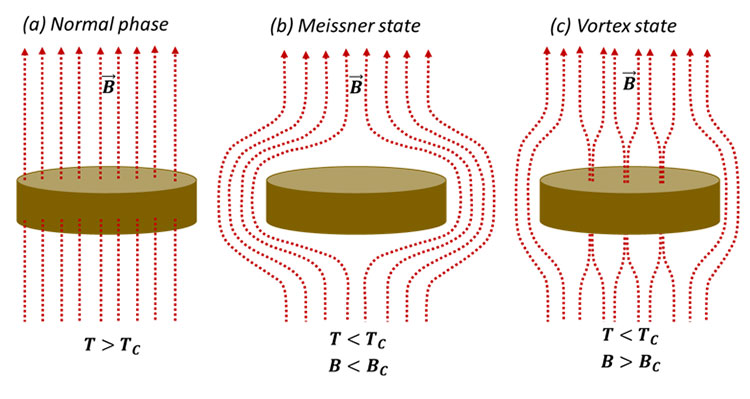
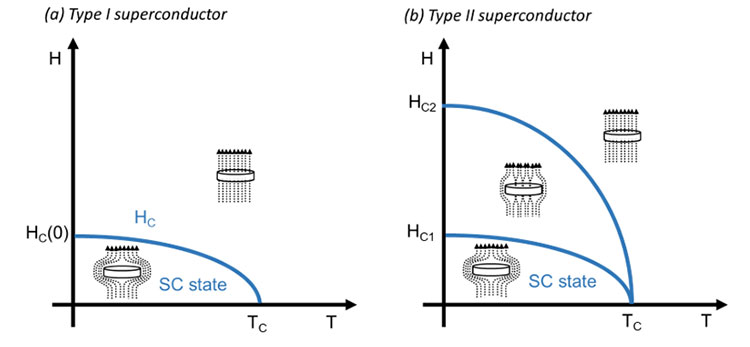
Superconductivity is a textbook case of a qualitatively new order arising when many electrons reorganize into a single, phase-coherent quantum state with macroscopic rules of its own. The experimental path was decisive. In 1911, Kamerlingh Onnes observed the sudden disappearance of electrical resistance in mercury; similar behavior was later observed in tin and lead [5]. In 1933, Meissner and Ochsenfeld showed that a superconductor cooled in a preexisting magnetic field expels that field from its interior [6]. In type-I superconductors this means complete expulsion below a critical field; in type-II materials the field is expelled up to a lower threshold and then enters as quantized vortices while the state remains superconducting (Box I). This history-independent expulsion is what distinguishes a superconductor from a merely perfect conductor, which would retain whatever field it started with.
Building on those milestones, the Bardeen–Cooper–Schrieffer (BCS) theory (1957) [7] supplied the microscopic picture (Box II). In a crystalline metal, lattice vibrations (phonons) produce a weak, retarded attraction between electrons near the Fermi level, binding them in Cooper pairs. Those pairs condense into a single macroscopic quantum state with a well-defined phase (shared timing), opening an energy gap that separates the ground state from excitations. With this framework, BCS turned superconductivity from puzzling observations into a quantitatively predictive theory: it accounts for the isotope effect [8,9], predicts the temperature dependence of the gap and critical parameters [10,11], and highlights phase rigidity (superfluid stiffness) as a key organizing principle underlying electrodynamics (Meissner screening, flux quantization, the Josephson effect). When the temperature reaches Tc, the condensate and, with it its stiffness, disappears and the system returns to ordinary resistive behavior. The deeper message is emergent: once pairs lock into a coherent condensate, the material is governed by the rules of that collective state rather than by the behaviors of individual electrons.
Emergence takeaway: In a normal metal, a single electron keeps bumping into impurities and vibrating atoms, losing energy as it goes. Nothing in that picture suggests a wire could carry current forever. Superconductivity only shows up when electrons act together. They share a common quantum phase, so the whole material responds collectively and resistance drops to zero. The key is not any single electron, but the coordinated collective state.
| Technical Box I - Superconductivity: A deeper dive. A superconductor, below the critical temperature Tc and for fields below the relevant critical thresholds, establishes equilibrium screening currents that expel or strongly suppress magnetic induction in its interior. In the full Meissner regime, the bulk field is essentially zero, apart from a thin surface layer set by the penetration depth λ. Meissner and Ochsenfeld’s discovery in 1933 [6] overturned the flux-freezing picture and showed that field exclusion is an equilibrium property, not just a dynamical consequence of ideal conductivity. That observation made a full thermodynamic treatment possible (free energy, entropy, heat-capacity jump, critical fields) rather than viewing superconductivity as mere “perfect conductivity”. While the macroscopic phenomenology was already established, the microscopic mechanism —how electrons pair and condense— was not understood until BCS theory (1957).
Type-I superconductors have a single critical field Hc(T). For H> Type-II superconductors have two critical fields, Hc1(T) and Hc2(T). For H>
|
| Technical Box II - Bardeen–Cooper–Schrieffer theory: a deeper dive. The Bardeen–Cooper–Schrieffer (BCS) formalism showed that superconductivity appears when electrons near the Fermi level feel a net attraction (in conventional metals, mediated by lattice vibrations/phonons). Below the critical temperature Tc, electrons form overlapping time-reversed pairs Cooper pairs (k↑,−k↓) and condense into a phase-coherent state described by the complex order parameter In BCS theory, the superconducting state is characterized by an energy gap |
 . In this condensate, a macroscopic fraction of electrons shares a common quantum phase and responds coherently. As fermions, electrons obey Fermi–Dirac statistics and the Pauli exclusion principle, so they cannot occupy the same single-particle quantum state. Superconductivity instead arises when electrons form Cooper pairs, which behave as bosons and can condense into a phase-coherent many-body state, giving rise to macroscopic coherence. In that regime, the useful variables are no longer single-electron scattering rates but the superfluid phase stiffness
  and two characteristic lengths: the penetration depth
  , whose motion and pinning set critical currents. The standard continuum descriptions —London equations, Ginzburg–Landau (GL) theory, and the Josephson relations— capture this behavior at the level where it lives: the phase and its gradients.
 in the single-particle excitation spectrum. As a result, the lowest-energy excitation above the ground state costs an energy
  (near kF), and breaking a Cooper pair costs
  . In the weak-coupling BCS regime, a relatively weak electron–phonon interaction gives rise to an effective attractive interaction acting only within an energy shell of width
  , with
 3. Quantum Hall physics: Topology as an organizing principle
When the electrons are confined to a very thin plane (two-dimensional electron system, 2DES), their motion perpendicular to the plane is quantized. Under low temperature and a strong magnetic field applied perpendicular to the plane, something remarkable appears in transport. In the early hours of 5 February 1980 , Klaus von Klitzing observed that the Hall resistance does not vary linearly with field (as in the classical Hall effect) but instead forms flat steps (plateaus) [12] (Box III). On each plateau, the Hall resistance  with ν=1, 2, 3… an integer and
  - where e is the electron charge and h is Planck’s constant- the von Klitzing constant. Within a plateau the value is essentially independent of material, device shape, and carrier density, while the longitudinal resistance
  falls to (nearly) zero. At low temperature and in a strong magnetic field, a little disorder leaves the interior trapped so it does not conduct and the current flows through chiral edge channels, producing the quantized Hall steps. This was the first clear sign that topology —a global property of the electronic states— can dictate electron transport.
Two years later, D. C. Tsui, H. L. Störmer, and A. C. Gossard observed fractional Hall plateaus at filling factors such as ν= 1/3 and 2/5. [13] (Box III) Here a single-particle picture fails. At certain fractional fillings, strong electron–electron interactions reorganize the system into an incompressible quantum fluid, in which the resulting new (quasi)particles carries a fraction of the charge of an individual electron. Crucially, this does not mean that the electron splits, as electrons remain indivisible. The fractional charge is a property of the collective state, not of an isolated particle. One year later, in 1983, R. Laughlin provided a compact mathematical description of the state (the Laughlin wavefunction) that captures the simplest odd-denominator fractions [14]. It encodes how electrons avoid one another in a strong magnetic field, producing an incompressible quantum fluid with a many-body energy gap and making the collective nature explicit. The lesson is clear: this is a genuinely emergent phase, with macroscopic rules that cannot be captured within a non-interacting electron picture.
Emergence takeaway: Track a single electron in a magnetic field and its motion is complicated and does not yield a precise, quantitative prediction for transport. In the quantum Hall effect, electrons confined in a very thin layer act together so the conductance locks to precise steps. The relevant description is set by the collective state (and its topological structure), not by any single electron trajectory.
| Technical Box III- Integer and fractional quantum Hall effects: A deeper dive. In the integer quantum Hall effect (IQHE), the Hall resistance forms quantized plateaus at
Figure 3: (a) Hall effect. A longitudinal conventional current I flowing under a perpendicular magnetic field Bz produces a transverse Hall voltage VH via the Lorentz force on the charge carriers. (b) Quantum Hall effect. In a strong perpendicular field Bz, electrons occupy Landau levels and bulk states become localized with cyclotron motion, while transport occurs through chiral edge channels. The red arrows indicate the direction of conventional current along the edges (electron drift is opposite). In the quantum Hall effect, transport current flows only along the edges, while the bulk remains localized (insulating), and the associated electrical resistance can only take on specific values. While the IQHE can largely be understood within single-particle quantum mechanics plus disorder and localization, in the fractional effect (fQHE) the plateaus arise from an interaction-built, incompressible quantum fluid [13]. Here, high sample quality (low disorder, high mobility) is essential to open and resolve the many-body gap, and disorder can weaken or even eliminate the more fragile fractions. Once the fractional gap is established, the quantization is again extremely precise. One year after experimental discovery of the fractional effect, R. B. Laughlin proposed a compact many-body wavefunction that captured the simplest odd-denominator sequence
Figure 4: Stepwise Hall resistance variation in magnetic field B in the (a) integer and (b) fractional quantum Hall effect. Plateau values are quantized in units set by h/e2. The lower peaked curve represents the Ohmic resistance, which disappears at each step. [Adapted from Nobel Prize – Press release] |
 while the longitudinal resistance
 falls to (nearly) zero on those plateaus. In 1980, Klaus von Klitzing —using a two-dimensional electron system (2DES) at low temperature and high magnetic field, with samples prepared by G. Dorda and M. Pepper— observed this stepwise dependence of
  on the field [12]. At low temperature, moderate disorder (essential for robust plateaus) broadens each Landau level and localizes most bulk states away from the level center. When the Fermi level lies in these localized regions, the bulk is effectively insulating and current flows in chiral edge channels, producing the plateaus. Within a plateau, the value is essentially independent of material, device shape, and carrier density. This universality has a topological origin: each plateau is labeled by an integer Chern number, ν, which cannot change unless the bulk mobility gap closes (so that extended states cross the Fermi level). [15]. The quantized plateau value of the Hall resistance is so accurate that
  with
with  (von Klitzing constant) became a resistance standard. Since the 2019 SI redefinition fixed e and h, the von Klitzing constant RK is exact by definition and the measurement of the IQHE provides a practical realization of
  at metrological accuracy.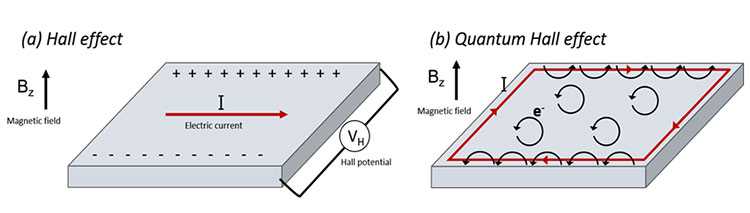
 by arranging the phase of the many-electron state so electrons avoid close encounters with one another [14]. This construction shows the states are incompressible: adding or removing an electron costs a finite energy, so the fluid resists density changes over a range of fields. It also predicts quasiparticles with fractional charge, even though individual electrons remain indivisible. Later experiments confirmed fractionally charged quasiparticles via shot noise and probed anyonic statistics with interferometry, making “fractionalization” a property of the collective state, not of an isolated electron.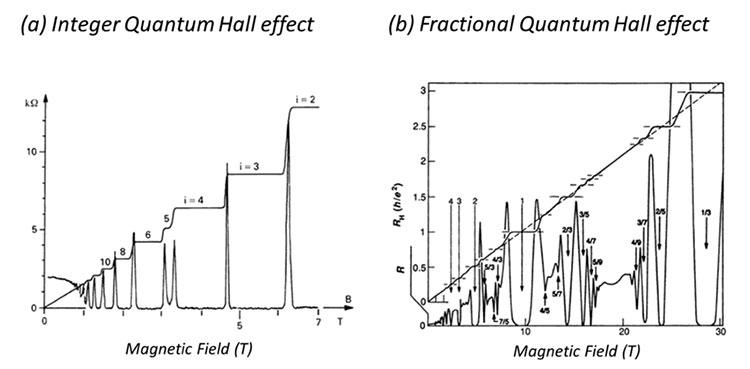
4. Moiré superconductivity: constructing conditions for emergence
In a crystal, electrons cannot assume arbitrary energies. They are confined to ranges of allowed electron energies (bands). When two graphene sheets are stacked with a small relative twist, the slight misalignment makes their lattices interfere, producing a long-wavelength moiré superlattice: an interference pattern that imposes a new, much larger periodicity on the material. This new periodicity folds the original band structure into minibands (Box IV).
At this specific angle, states from the two layers hybridize strongly. Because of strong interlayer hybridization, some of these minibands become very narrow (small bandwidth W) near charge neutrality: the dispersion is nearly flat and the group velocity of the carriers is strongly reduced. As electron motion slows, many electronic states crowd into a narrow energy window (the density of states rises), and the electronic weight is enhanced in AA-stacked regions that form an emergent triangular network. These are still extended states, not electrons pinned to a single point. As the bandwidth W becomes small, electrons move slower, the electron–electron correlations dominate over kinetic energy and the system is predisposed to collective phases. In 2018, “magic-angle” twisted bilayer graphene (tBLG) revealed correlated insulators and superconductivity near a twist angle of about 1.1º [16].
Moiré materials turn geometry into a dial for emergence. By choosing a twist angle during fabrication and then tuning the device via gates, fields, pressure, or strain, we modify electron motion and enhance their mutual influence. This enables exploration of a wide phase diagram, with new collective phases emerging within the same device, avoiding the need to grow a new crystal for every parameter set and exposing physics that cannot be reduced to single-electron behavior. In situ control makes it possible to map trends systematically and separate universal signatures from sample-dependent artifacts. In that sense, these stacks are more than materials: they are a tabletop laboratory where we can explore —and increasingly design— new emergent phases, superconductivity included.
Emergence takeaway: An electron in graphene is highly mobile. Twisting two graphene layers by a tiny angle, the electronic bands narrow and the whole electron system slows down. In that regime, interactions become decisive, and correlated phases such as insulating states or superconductivity can appear. The enabling factor is geometric: the moiré overlap pattern reshapes the band structure and makes these collective phases accessible.
| Technical Box IV- Flat bands in graphene: A deeper dive A moiré pattern is a long-wavelength interference pattern that emerges when two periodic layers are overlaid with a slight twist or lattice mismatch. The resulting moiré period in real space is, to first approximation, inversely proportional to the twist angle. In momentum space, this relative rotation displaces the Dirac points (Dirac cones) of the two layers by In 2018, “magic-angle” twisted bilayer graphene (tBLG) revealed correlated insulators and superconductivity near a twist of about 1.1º [16]. At this specific angle, the Dirac cones from each layer hybridize strongly, and this hybridization flattens the bands near charge neutrality: instead of the steep cone characteristic of massless fermions, the dispersion becomes nearly flat, the bandwidth W shrinks, and the Fermi velocity vF is strongly reduced. With motion suppressed, many states crowd into a narrow energy window (the density of states rises), and the electronic weight is enhanced in AA-stacked regions of the moiré cell, forming an emergent triangular modulation of the wavefunction amplitude rather than true real-space localization. Once the bandwidth is small, even moderate Coulomb repulsion becomes decisive: when the interaction energy rivals or exceeds the bandwidth W, electrons end to behave as nearly independent particles and collective phases appear. In this interaction-dominated regime, correlated insulating states occur at integer fillings of the moiré unit cell. When the filling is tuned slightly away from those integers (for example, with electrostatic gates), superconducting “domes” emerge: regions of the phase diagram (typically Tc versus filling/doping, or versus field/pressure) with a dome-like shape where superconductivity is present. A key novelty of moiré materials is the variety of control knobs that reshape the minibands and their overall pattern: twist angle, gate voltages, perpendicular displacement fields, pressure, and strain allow us to tailor low-energy behavior on a single device [17, 18]. In aligned devices, these controls can also stabilize Chern-polarized states and even quantum anomalous Hall phases, highlighting the close competition among orders in flat bands [19]. We are not only discovering collective phases; we are creating the conditions under which they appear.
|
 , creating a smaller Brillouin zone and enabling strong interlayer coupling.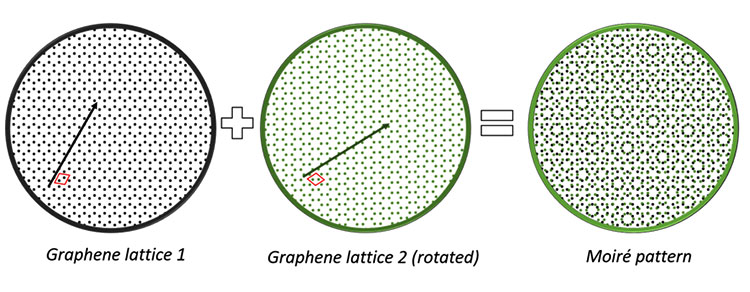
5. From constituents to constraints
Taken together, these three milestones trace not just scientific progress but a shift in how physics understands matter. Superconductivity showed that collective order can rephrase electrodynamics of a metal. The quantum Hall effect —first the integer effect, then the fractional—sharpened the point: collective interactions and global structure can lock a macroscopic response to exact, quantized values. Moiré systems take the next step, showing that we can now shape the constraints —flat bands, symmetry, filling— so that the collective state we seek is the one that emerges. In each case, an organizing variable (phase stiffness, topological invariant, or bandwidth control) plus a tunable constraint produces a law at the macroscopic level that is insensitive to many microscopic details.
The change has a clear timestamp: the APS meeting in 2018 when Pablo Jarillo-Herrero first unveiled moiré phase diagrams. That moment, the energy in the room recalled what Klaus von Klitzing describes from that night of measurements in Grenoble in 1980: a threshold had been crossed. One case revealed a macroscopic response locked to universal constants; the other showed that a slight twist and an electrostatic gate can stabilize or suppress correlated phases within a single device on demand. Different materials, but the same methodological lesson: explanation shifts from tracking constituents one by one to identifying the organizing principles that control the macroscopic regime.
Philosophically, the shift here is not a rejection of reductionism but a reframing of what counts as explanation: microscopic laws remain the foundation, yet effective variables and constraints are what make complex behavior intelligible and predictable. We use “emergent” in a methodological sense: identify the right coarse variables, the constraints that stabilize them, and the invariants they enforce. Practically, we work in the ‘derivable-in-principle’ regime: even when the full derivation is not available, the right collective variables make the behavior predictable and controllable. That stance links the three episodes we discuss: phase stiffness in superconductors, Chern topology in the quantum Hall effect, and flat-band engineering in moiré materials. The frontier is less about prediction than about recognizing and controlling emergence.
Much of today’s condensed-matter landscape lives in this “epistemic middle”: we can probe and even program emergent rules long before every detail is derived from first principles. That is not a weakness. This “epistemic middle” is also where modern materials engineering operates: we can design and control devices by manipulating robust effective degrees of freedom, without waiting for a final “Theory of Everything” or an explicit solution of the full microscopic problem. [20] It is a sign that physics works at multiple, equally valid, levels of description. In that sense, moiré engineering is a method, not an end: a way to expose which ratios —interaction to bandwidth, and the interplay of symmetry with band structure— actually govern the phase, and to move those ratios with macroscopic dials until the desired collective order writes its own effective laws.
| Synthesis Box: Organization sets the rules. Even if the many-body Schrödinger equation contains the full description in principle, condensed-matter progress relies on compression: identifying collective variables, gaps and invariants that remain stable under coarse-graining. In that sense, emergence is not a denial of microscopic laws, but a statement about explanation and prediction: effective theories are the level at which complex matter becomes controllable. In superconductors, a shared phase makes resistance vanish to zero. In the integer quantum Hall effect, topology together with moderate disorder locks conductance into precise steps of e2/h. In the fractional case, interactions produce an incompressible fluid with fractional plateaus. In moiré systems, a small twist and electrostatic gating narrow the bands so correlations dominate. A single-electron picture captures trajectories and velocities, but not these quantized and collective responses. These behaviors emerge when electrons form a coherent collective state: the effective macroscopic rules are set by the organizing principles of that state, not by any single electron alone. |
6. Glossary of Core Terms (Physics & Emergence)
Emergence (weak vs. strong).
Order that appears at the collective level, which is immediately not obvious from individual constituents. Weak emergence describes phenomena that are derivable in principle once the right coarse-grained variables are identified. Strong (epistemic) emergence suggests that no tractable derivation is currently known at the relevant scales, without implying any in-principle violation of microscopic laws.
Why it matters: it frames the methodological of identify variables and constraints that dictate macroscopic rules.
Organizing variable.
The collective quantity that governs macroscopic behavior (e.g., phase stiffness in SC, Chern number in IQHE, U/W ratio in moiré systems).
Why it matters: it the shifts explanation from tracking particles to describe universal patterns.
Constraint engineering.
The deliberate designing of geometry/symmetry/filling to stabilize a desired phase.
Why it matters: it marks the transition from “discovering” matter to “designing” it.
Universality (Insensitivity).
The property of macroscopic laws to remain robust regardless of microscopic details (like impurities or disorder) once the organizing variable is fixed.
Why it matters: it justifies why simple, effective theories can predict complex, robust phenomena.
Applied Magnetic Field (H).
The "external stimulus" generated by laboratory equipment. It is the independent variable used in phase diagrams.
Why it matters: It defines the experimental threshold on the superconductor.
Magnetic Flux Density (B).
The actual magnetic field present inside the material. It represents the density of magnetic field lines (flux) that have penetrated the sample.
Why it matters: It describes the internal reality. In flux line or vortex schematics, B is used to show how the magnetic field is distributed or expelled (Meissner effect) within the material’s bulk.
Cooper Pairs (k↑,−k↓).
Pairs of electrons with opposite momenta and spins that overlap to form a "composite boson."
Why it matters: Unlike fermions, these pairs condense into a single macroscopic quantum state.
Energy Gap (Δ).
The energy of the minimum electronic excitation.
Why it matters: It represents the stability of the superconducting state. In the BCS regime, 2Δ is the energy cost to disrupt the collective order.
Superconducting order parameter. : magnitude is proportional to ns, phase φ encodes coherence. Losing long-range phase order destroys superconductivity.
Why it matters: centers “phase rigidity.”
Debye Energy (ℏωD)
The energy scale of the lattice vibrations (phonons) that mediate the electron attraction.
Why it matters: It sets the energy range over which the microscopic pairing interaction is effective, defining the boundary for the weak-coupling attraction.
Josephson effect.
Coherent tunneling of Cooper pairs; phase difference drives supercurrent.
Why it matters: a direct probe of long-range phase order.
Complex Order Parameter (ψ=∣ψ∣eiϕ)
A single mathematical function that describes the entire collective of Cooper pairs. Its amplitude ∣ψ∣ relates to the density of superconducting fraction (many pairs are condensed), while its phase ϕ encodes the coherence of the states.
Why it matters: It replaces the need to track 1023 electrons.
Phase Stiffness (ρs).
A measure of the "rigidity" of the quantum phase. It represents the energy cost of creating a spatial gradient in the phase (∇ϕ).
Why it matters: This is the physical anchor of superconductivity. Because the phase is "stiff," the system resists change, leading to lossless currents.
Superfluid Phase (ϕ).
The quantum "angle" shared by all pairs in the condensate.
Why it matters: It is the natural language of the system. In the macroscopic regime, gradients of this phase dictate the velocity of the supercurrent.
Penetration Depth (λ).
The distance over which an external magnetic field is screened and decays to zero inside the material.
Why it matters: It quantifies the Meissner effect. It tells us how effectively the "organizing principle" of the phase can push out external magnetic influence.
Coherence Length (ξ).
The characteristic size of a Cooper pair or the distance over which the superconducting order parameter can vary.
Why it matters: It defines the "resolution" of the superconductor. The ratio between λ and ξ determines whether a material is Type-I or Type-II.
Filling factor ν.
The number of filled Landau levels (IQHE) or rational values set by electron-electron interactions (FQHE).
Why it matters: the parameter that labels the quantized plateaus.
Landau levels (LLs).
Quantized cyclotron orbits in a 2D system under a magnetic field.
Why it matters: They provide the "scaffold" for quantization; disorder broadens these levels into bands, allowing for stable plateaus.
Cyclotron Motion.
The circular orbits of electrons driven by the Lorentz force in the bulk of the sample.
Why it matters: In the plateau regime, disorder localizes bulk states; extended states occur near Landau Level centers, effectively turning the interior of the material into an insulator and forcing current to the boundaries.
Chern number (TKNN).
An integer topological invariant that labels each quantized Hall conductance plateau.
Why it matters: It is the ultimate organizing variable. It is a topological invariant that remains unchanged under smooth perturbations (such as moderate disorder) provided the relevant (mobility) gap does not close.
Edge states (chiral).
One-way channels at the edges (boundaries) of the sample that carry current while the interior (bulk) remains insulating.
Why it matters: They connect transport to topology via bulk–edge correspondence.
Fractionalization charge & Anyons.
The emergence of quasiparticles with fractional charge e∗=e/m (m odd for the Laughlin sequence) and non-standard (anyonic) statistics.
Why it matters: Definitive evidence that the collective state is a new entity with properties not found in isolated electrons.
Magic angle & flat bands.
A specific twist angle (e.g., θ ≈1.1 deg. or graphene) where the electron velocity nearly vanishes.
Why it matters: It produces flat bands (narrow bandwidth W), making electron-electron interactions dominant.
Interaction-to-bandwidth ratio (U/W)
The effective control parameter in moiré lattices, where U represents the Coulomb repulsion and W, the bandwidth.
Why it matters: A large U/W favors the emergence of correlated insulators and superconductivity.
AA-stacking weight modulation.
A spatial redistribution of the electron's probability density toward specific regions of the moiré pattern.
Why it matters: It creates a triangular "scaffold" for electrons to interact without the need for traditional atomic trapping.
Correlated insulators & superconducting domes.
Insulators at integer fillings. Superconducting “domes” emerge upon doping/field/pressure tuning.
Why it matters: the textbook map for “designing” phases.
References
1. P. W. Anderson, More is different: broken symmetry and the nature of the hierarchical structure of science. Science 177, 393-396 (1972)
2. P. M. Etxenique, En memoria de Phil W. Anderson (1923-2020), Revista española de física, Vol. 34, Nº. 3 (2020)
3. R. B. Laughlin, Nobel Lecture: Fractional quantization, Reviews of Modern Physics, 71, 863 (1999)
4. M. Tinkham, Introduction to superconductivity. Dover Publication, INC. Mineola, NY. 2004
5. H. Kamerlingh Onnes, Communications of the Physical Laboratory of the University of Leiden, no 120b. (1911)
6. W. Meissner and R. Ochsenfeld, Ein neuer Effekt bei Eintritt der Supraleitfähigkeit. Naturwissenschaften. 21 (44): 787–788 (1933)
7. J. Bardeen, L. N. Cooper, and J. R. Schrieffer, Microscopic Theory of Superconductivity, Phys. Rev. 106, 162 (1957)
8. E. Maxwell, Isotope Effect in the Superconductivity of Mercury. Phys. Rev. 78, 477 (1950)
9. C. A. Reynolds, et al., Superconductivity of Isotopes of Mercury. Phys. Rev. 78, 487 (1950)
10. J. Bardeen, L. N. Cooper, and J. R. Schrieffer, Theory of Superconductivity. Phys. Rev. 108, 1175 (1957)
11. I. Giaever, Energy Gap in Superconductors Measured by Electron Tunneling, Phys. Rev. Lett. 5, 147 (1960)
12. K. von Klitzing et al., New Method for High-Accuracy Determination of the Fine-Structure Constant Based on Quantized Hall Resistance, Phys. Rev. Lett. 45, 494–497 (1980)
13. D. C. Tsui et al., Two-Dimensional Magnetotransport in the Extreme Quantum Limit, Physical Review Letters 48, 1559–1562 (1982)
14. R. B. Laughlin, Anomalous Quantum Hall Effect: An Incompressible Quantum Fluid with Fractionally Charged Excitations, Phys. Rev. Lett. 50, 1395 (1983)
15. D. J. Thouless, M. Kohmoto, M. P. Nightingale, and M. den Nijs, Quantized Hall Conductance in a Two-Dimensional Periodic Potential, Phys. Rev. Lett. 49, 405 (1982)
16. Y. Cao et al., Unconventional superconductivity in magic-angle graphene superlattices, Nature 556, 43–50 (2018)
17. L. Balents et al., Superconductivity and strong correlations in moiré flat bands, Nature Physics 16, 725–733 (2020)
18. D. M. Kennes et al., Moiré heterostructures as a condensed-matter quantum simulator, Nature Physics 17, 155–163 (2021)
19. Serlin et al., Intrinsic quantized anomalous Hall effect in a moiré heterostructure, Science 367, 900–903 (2020)
20. R. B. Laughlin and D. Pines, The Theory of Everything, PNAS 97, 28–31 (2000)
Further reading
21. J. A de Azcárraga, Reduccionismo y emergencia, de nuevo. Real Sociedad Española de Física (2024)
22. R. C. Bishop, The Physics of Emergence, IOP (2024)
23. D. van Delft and P. Kes, The discovery of superconductivity, Phys. Today 63(9), 38–43 (2010)
24. D. Lindley, Landmarks: Superconductivity Explained, Phys. Rev. Focus 18, 8 (2006)
25. D. Goodstein, J. Goodstein, Richard Feynman and the History of Superconductivity, Physics in Perspective 2, 30–47 (2000)
26. R. Feynman, The Schrödinger Equation in a Classical Context: A Seminar on Superconductivity, Feynman Lectures on Physics, Vol 3, Chap. 21 - 1
27. R. E. Prange and S. M. Girvin, The Quantum Hall Effect, 2nd ed. (Springer-Verlag New York Inc, 1990)
28. J.P. Eisenstein and H.L. Stormer, The fractional quantum Hall effect, Science 248, 1510 (1990)
29. Horst L. Stormer, Nobel Lecture: The fractional quantum Hall effect, Reviews of Modern Physics, 71, 875 (1999)
30. K. von Klitzing et al., 40 years of the quantum Hall effect, Nature Reviews Physics 2, 397–401 (2020)
31. K. von Klitzing, 25 Years of Quantum Hall Effect (QHE): A Personal View on the Discovery, Physics and Applications of this Quantum Effect, Séminaire Poincaré 2 (2004)
32. E. Y. Andrei and A. H. MacDonald, Graphene bilayers with a twist, Nature Materials 19, 1265–1275 (2020)
COMPARTIR
